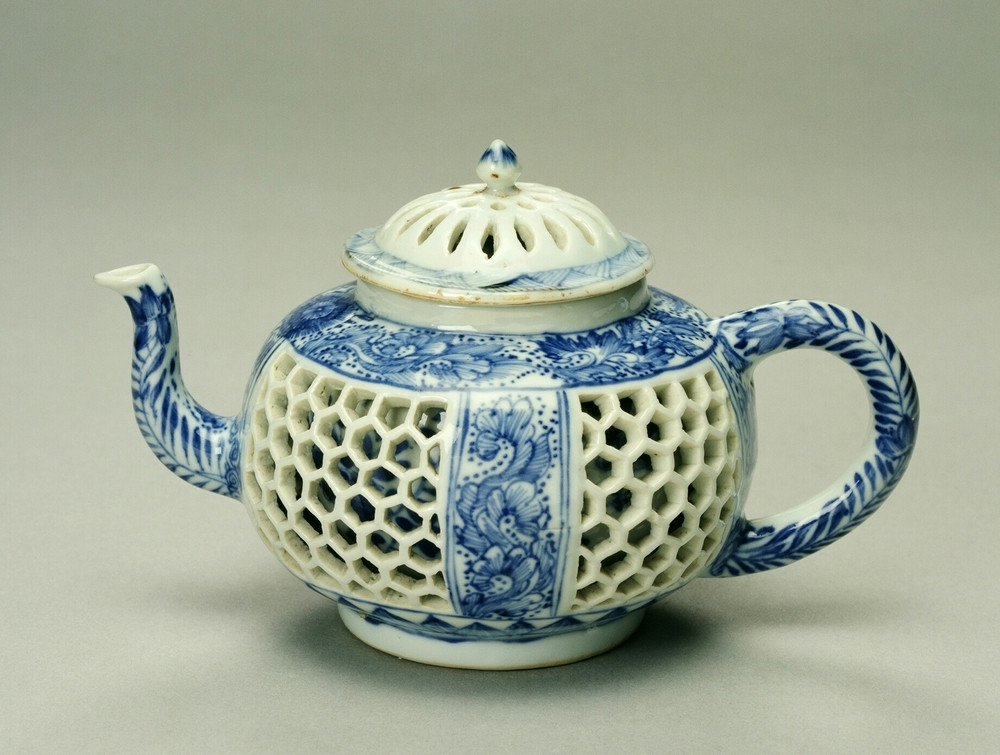
Teapot on footring, globular, double-walled, partly open-worked body, wide low mouthrim, domed lid with knob. S-shaped spout and C-shaped handle. The sides with four rectangular panels, open-worked in a honeycomb pattern, Linglong of Devils work. Wide bands all around, decorated in underglaze blue with a full pattern of flower and foliate scrolls. The inside is decorated with figures in a landscape. On the spout and ear a flower spray. The lid is also open-worked. Manufacturing open-worked pieces for export was fashionable in the first quarter of the 18th century. During the potting process the outer sides were luted to the mouthrim and foot. In this example, the inner sides were painted first. A chisel was used to carve the pattern in the soft clay of the outer sides, whereafter it was painted and fired. The Chinese called this technique linglong, ‘delicate open-work’, or also ‘devil’s work’; this last perhaps not surprising considering the enormous skill required to create such complex pieces.
Teapot on footring, globular, double-walled, partly open-worked body, wide low mouthrim, domed lid with knob. S-shaped spout and C-shaped handle. The sides with four rectangular panels, open-worked in a honeycomb pattern. Wide bands all around, decorated in underglaze blue with a full pattern of flower and foliate scrolls. The inside is decorated with figures in a landscape. On the spout and ear a flower spray. The lid is also open-worked. Manufacturing open-worked pieces for export was fashionable in the first quarter of the 18th century. During the potting process the outer sides were luted to the mouthrim and foot. In this example, the inner sides were painted first. A chisel was used to carve the pattern in the soft clay of the outer sides, whereafter it was painted and fired. The Chinese called this technique linglong, ‘delicate open-work’, or also ‘devil’s work’; this last perhaps not surprising considering the enormous skill required to create such complex pieces.