Pot

Meer informatie
17e eeuw
Collectie
Jan Menze van Diepen Stichting
Beschrijving

Theepot op voetring, bolvormige, dubbelwandige, deels opengewerkte buik, brede lage mondrand, gewelfd deksel met knop. S-vormige tuit en C-vormig handvat. De wand heeft vier rechthoekige vakken, opengewerkt in een honingraat patroon, Linglong of Devils work. Rondom brede banden, versierd in onderglazuur blauw met een vol patroon van bloem- en bladranken. De binnenwand is beschilderd met figuren in een landschap. Op tuit en oor een bloemtak. Ook het deksel is opengewerkt. Het vervaardigen van opengewerkte stukken voor export was vooral in de mode in het eerste kwart van de 18e eeuw. Bij het vormen werd een dubbele wand aangebracht die bij mondrand en voet werden samengevoegd. In dit geval was de binnenwand eerst beschilderd en geglazuurd voor de buitenwand werd aangebracht. Met een mes werd in de nog zachte klei van de buitenwand het patroon uitgestoken, waarna ook de buitenwand werd beschilderd en het stuk gebakken werd. Deze techniek werd door de Chinese linglong, ‘delikaat open werk’, ook wel ‘duivelswerk’ genoemd, niet ten onrechte, gezien de grote vakbekwaamheid die voor dit werk noodzakelijk was.
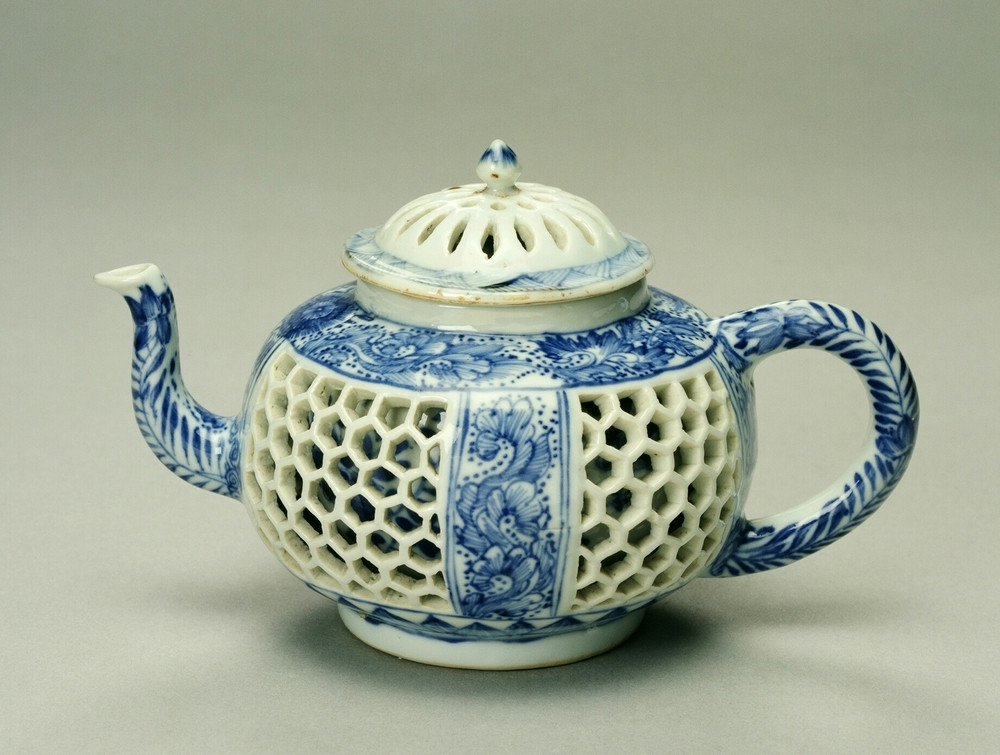
Teapot on footring, globular, double-walled, partly open-worked body, wide low mouthrim, domed lid with knob. S-shaped spout and C-shaped handle. The sides with four rectangular panels, open-worked in a honeycomb pattern, Linglong of Devils work. Wide bands all around, decorated in underglaze blue with a full pattern of flower and foliate scrolls. The inside is decorated with figures in a landscape. On the spout and ear a flower spray. The lid is also open-worked. Manufacturing open-worked pieces for export was fashionable in the first quarter of the 18th century. During the potting process the outer sides were luted to the mouthrim and foot. In this example, the inner sides were painted first. A chisel was used to carve the pattern in the soft clay of the outer sides, whereafter it was painted and fired. The Chinese called this technique linglong, ‘delicate open-work’, or also ‘devil’s work’; this last perhaps not surprising considering the enormous skill required to create such complex pieces.

Teapot on footring, globular, double-walled, partly open-worked body, wide low mouthrim, domed lid with knob. S-shaped spout and C-shaped handle. The sides with four rectangular panels, open-worked in a honeycomb pattern. Wide bands all around, decorated in underglaze blue with a full pattern of flower and foliate scrolls. The inside is decorated with figures in a landscape. On the spout and ear a flower spray. The lid is also open-worked. Manufacturing open-worked pieces for export was fashionable in the first quarter of the 18th century. During the potting process the outer sides were luted to the mouthrim and foot. In this example, the inner sides were painted first. A chisel was used to carve the pattern in the soft clay of the outer sides, whereafter it was painted and fired. The Chinese called this technique linglong, ‘delicate open-work’, or also ‘devil’s work’; this last perhaps not surprising considering the enormous skill required to create such complex pieces.

Details
Datering
17e eeuw
Materiaal/techniek
gebakken
keramiek
Inventarisnummer
JMD-P-2189
Objectsoort