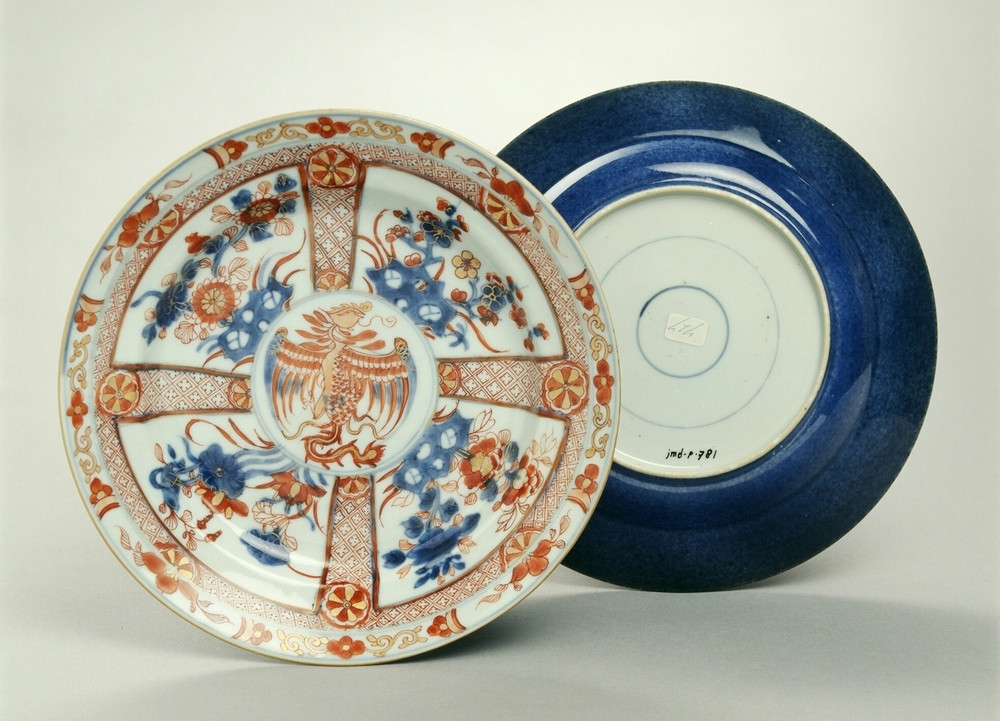
Two dishes on footring, flat rim. Chinese Imari, decorated in underglaze blue, iron-red and gold on the glaze. In the centre a medallion with a phoenix, around it four panels with a rock and flowering plants (chrysanthemum, prunus, peony and lotus) separated by bands with diamond-work and a kiku flower (a stylised Japanese chrysanthemum), a similar continuous band around the sides. On the rim flower scrolls and four elongated panels with a flower spray. The reverse of the sides and rim covered with a powder blue glaze. The base glazed white with two circles in underglaze blue. Chinese Imari was produced by the Chinese potters in response to the successful Japanese Imari, which was characterised by a decoration in underglaze blue, iron-red and gold, sometimes with additional enamel colours. It was produced in Arita for export from c. 1680. Chinese Imari, made from c. 1710, imitated the colour scheme. The composition and motifs are sometimes taken from a Japanese model, but usually only one or two Japanese elements are incorporated or the design is purely Chinese in content. Chinese Imari, or ‘Chinese Japanese’ as it is referred to in the VOC archives, was an extremely popular ex...
More information
Collectie
Jan Menze van Diepen Stichting
Beschrijving