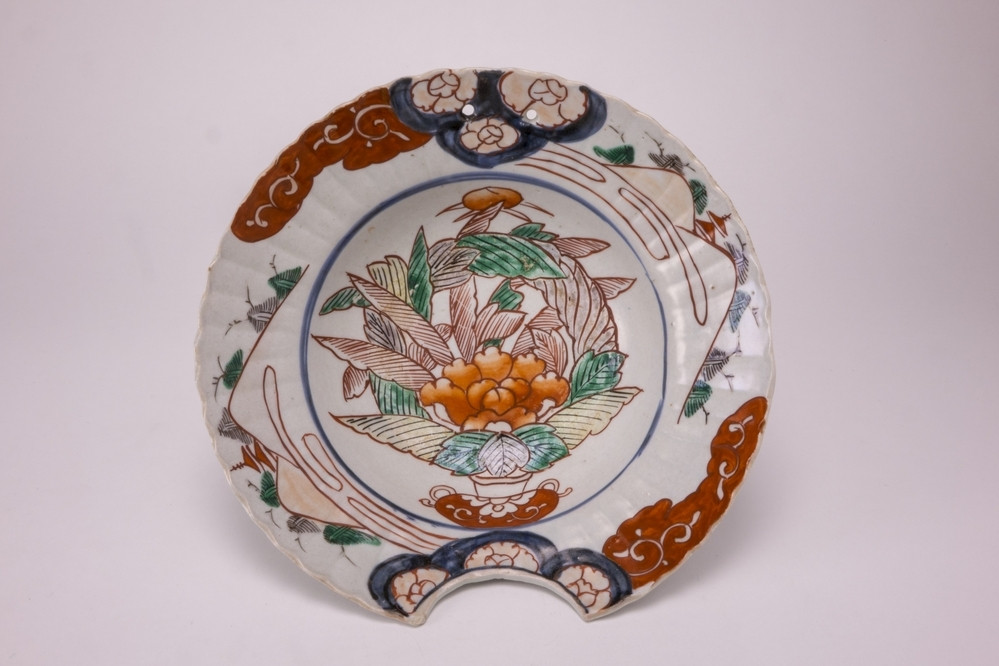
Shaving bowl on a high footring. Moulded ribbed rim with a saved semi-circular section and two small holes opposite the cut-out section. Decorated in underglaze blue and overglaze iron-red, black, green, grey and yellow enamel with a jardinière filled with a leafy flowering peonies. On the rim a mountainous landscape with trees and a pagoda alternating with three peony flower heads reserved on a underglaze blue ground. On the reverse two wide spread prunus sprays. Shaving bowls were used by barbers and were indispensable in the Dutch household too. They were made of earthenware, pewter, copper and even silver. They had an alternative use, namely to let blood from a vein in the arm during blood-letting, a medical procedure thought to drain bad blood from the system also performed by the barber/surgeon. In the seventeenth century, regulations were put in place in England to govern what barbers were permitted to do. Thus the became confined to bloodletting and treating external diseases. In Prussia the barbers' and the surgeons' guild joined in 1779, and it was said of great Prussian surgeons that they had risen "up from the barber's bowl'. Both purposes explain the semi-circula...
More information
Collectie
Jan Menze van Diepen Stichting
Beschrijving