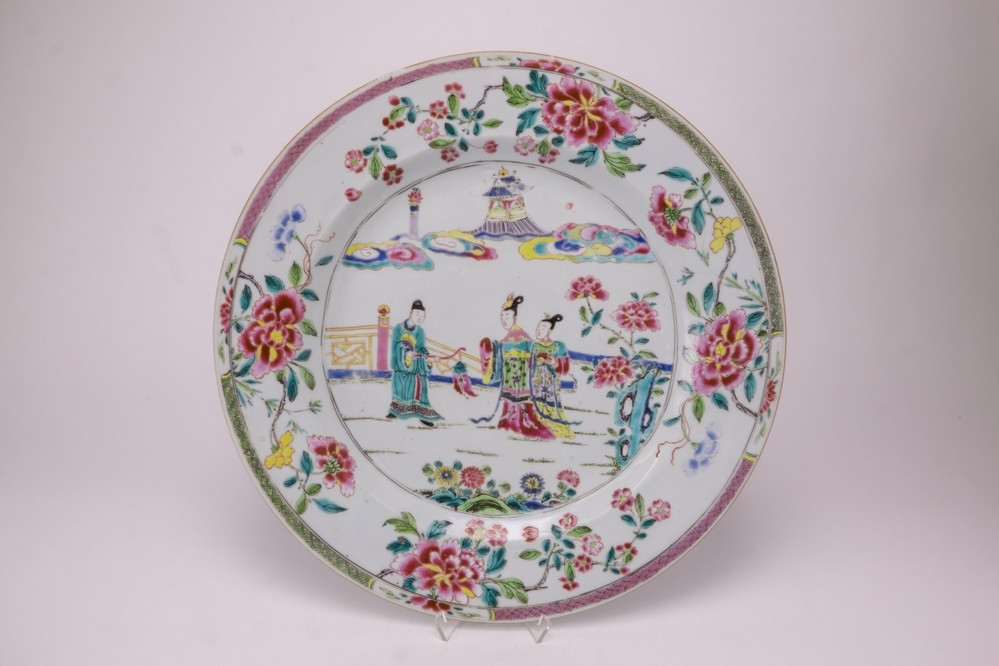
Dish on footring, flat rim. Famille rose, decorated in various shades of green, blue, yellow, black and pink with two women on a veranda, a servant with a lantern, flowering plants and a rock. In the background a cloud-bank and a pavilion roof. On the sides and rim four peony sprays. Around the rim a small band with diamond-work in pink and green, separated by four medallions each with a half-peony. On the reverse four flower sprays in red. Around 1725, a new enamel colour was added to the porcelain painter’s palette: pink. This colour, developed in the Imperial workshops in Beijing, was achieved by adding a small amount of gold in a colloidal solution to the glaze. It was soon the most prominent colour on export porcelain, supplanting famille verte. Adding white enamel produced variegation in the opaque pink, as can be seen here. Various shades of green enamels were also used on this dish and, like the paleness of the pink, indicate a relatively early dating. As famille verte, the name famille rose was also invented by Albert Jacquemart (1862) and has been the standard term ever since. It is not distinguished in the VOC archives and is simply called ‘geamaljeerd’ (enamelled). ...
More information
Collectie
Jan Menze van Diepen Stichting
Beschrijving