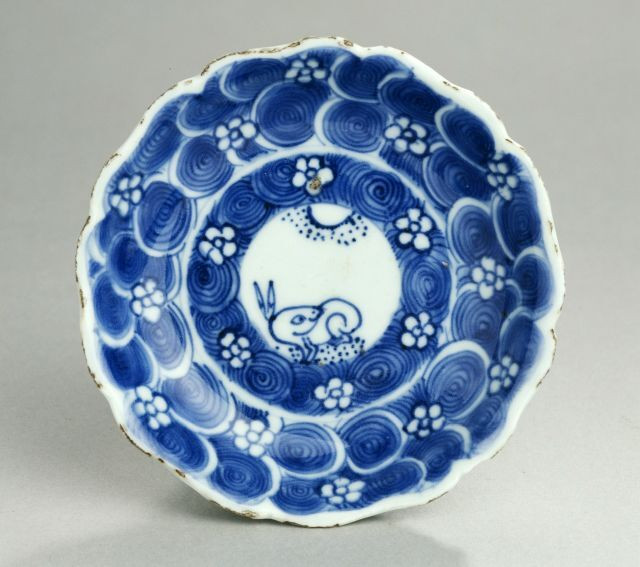
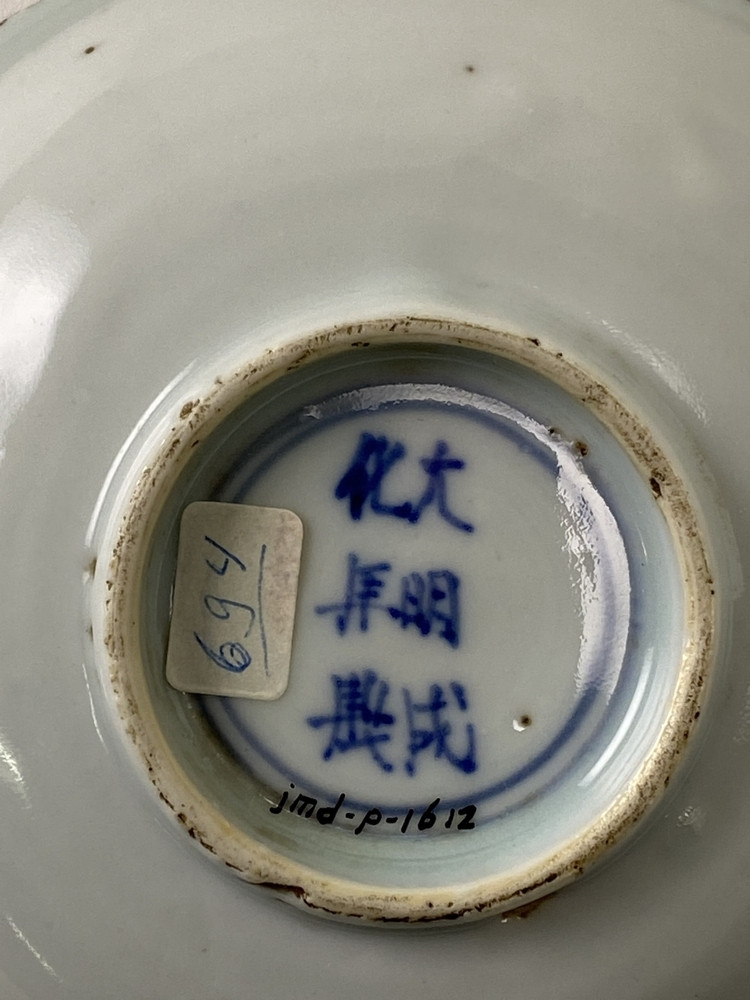
Small saucer on footring, spreading sides, lobed rim. Decorated in underglaze blue. In the centre a hare and a moon surrounded by a band of spiral motifs and single blossoms, on the sides a double row of similar spirals with blossoms. On the base the six-character mark Chenghua. According to Chinese mythology, the white hare was born of the moon’s essence and consequently fell under its influence. The does became pregnant by looking at the moon, as seen here. It is also said that a hare lives on the moon and spends its days under a cassia tree pounding the Elixir of Life in a mortar and pestle. The spirals represent waves, the floating blossoms symbolise transience. Porcelain with comparable motifs was found in the Hatcher wreck, c. 1643 (Sheaf & Kilburn) and evidently was popular at the time. Although this type was not specifically made for Europe, examples have been found there. Besides domestic use in China, these were primarily destined for the inter-Asian market and Japan. These small saucers had no matching cup, and were used to serve small portions of food or condiments.
More information
Collectie
Jan Menze van Diepen Stichting
Beschrijving