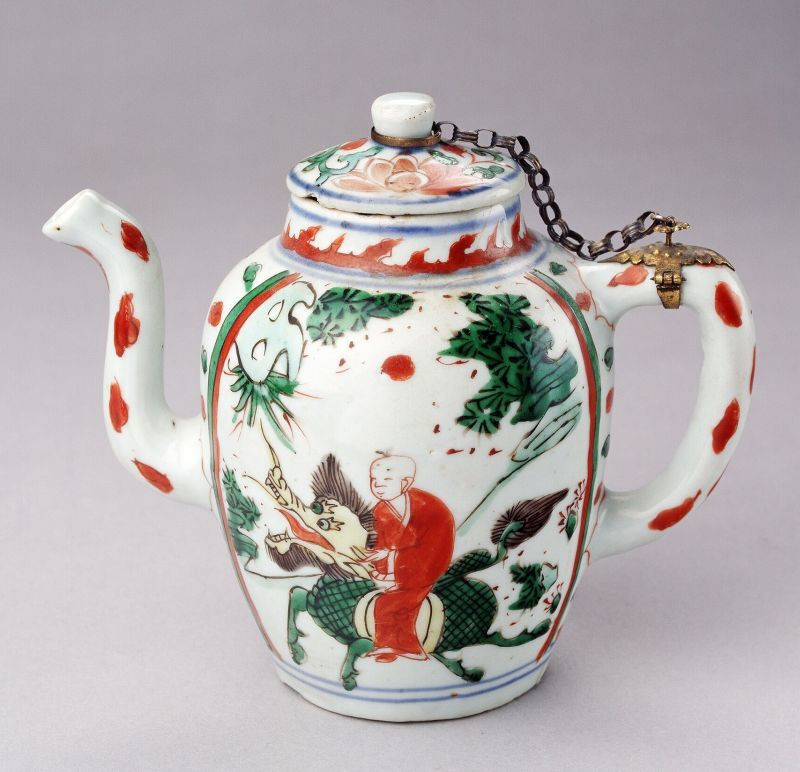
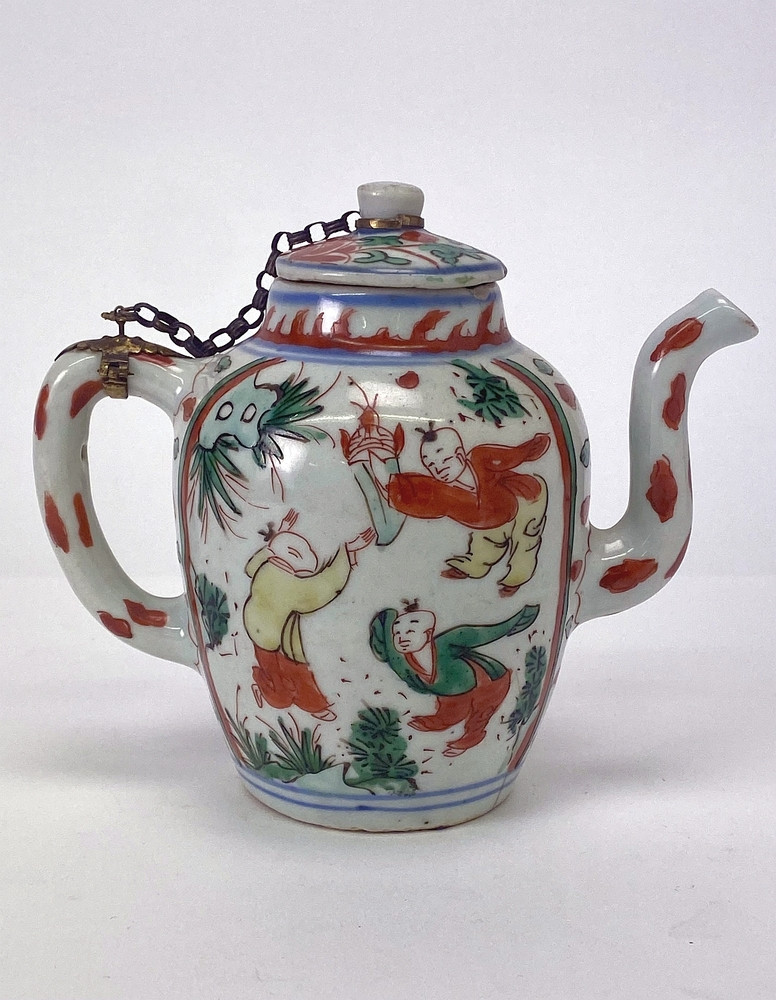
Tall teapot on footring, wide mouthrim, low conical lid with knob. Long, S-shaped spout, C-shaped handle. Decorated in iron-red, two shades of green, yellow and black enamel on the glaze. Around the foot, on the shoulder, around the mouth and on the lid circles in underglaze blue. On the body two large panels. In one a Chinese figure riding a kylin, in the other three dancing boys. A flower scroll on the lid. A partly silver gilt mount was fitted later in Europe. The boy on the kylin and the dancing boys symbolise countless generations of sons. As a new item, transitional porcelain in enamel colours had the potential to be extremely successful in The Netherlands, but production was halted by Chinese civil wars before it became established in Europe. Most enamelled porcelain of this period was intended for south-east Asia or, as ko-akae, for Japan. Tea drinking, and thus teapots, was normal in Asia, but still had to become popular in The Netherlands. An almost identical example is in the Groninger Museum, Groningen (unpublished).
More information
Collectie
Jan Menze van Diepen Stichting
Beschrijving