Addendum on the subsequent journey of the pots, by Lucas Bourdrez, grandson of Frans Bourdrez (correspondence with Jan van Campen, 13 January 2026):
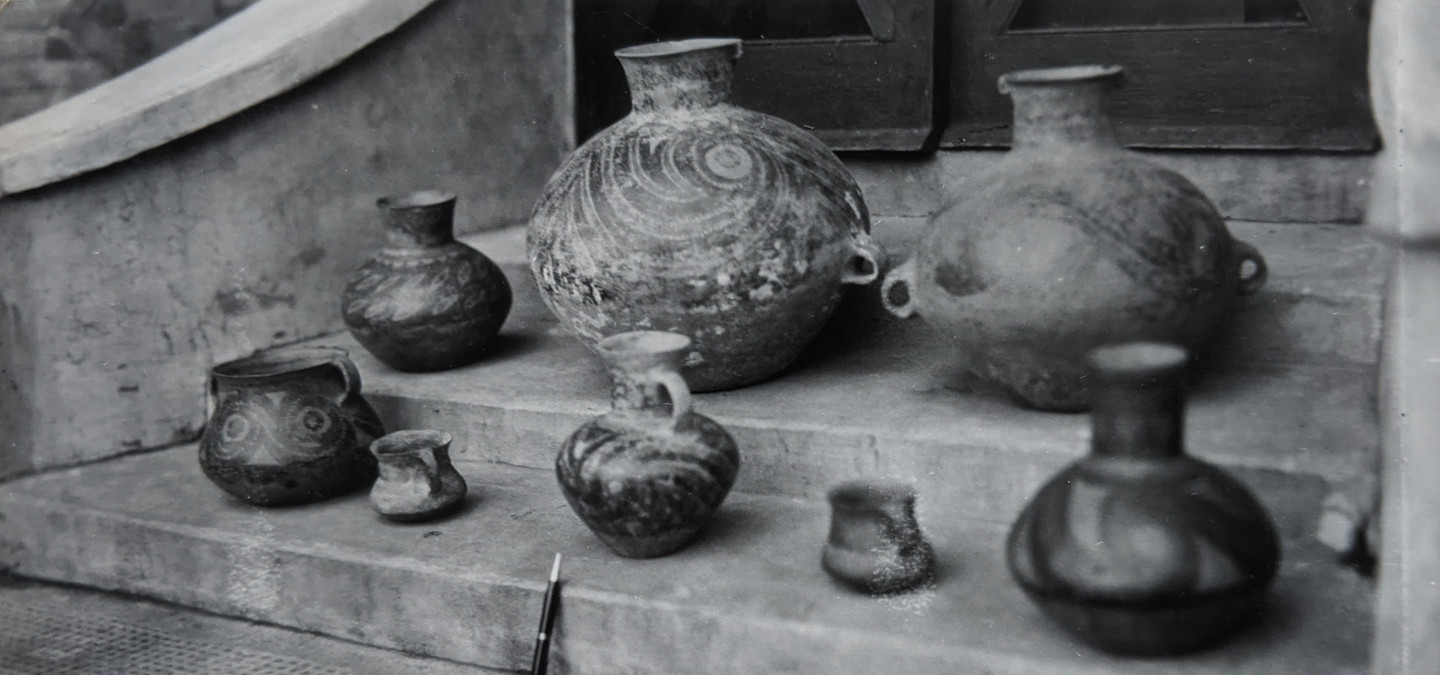
‘It was a close call that the pots survived at all. As mentioned, Frans Bourdrez took the pots with him on the flight back home to what was then the capital, Nanjing, at the expense of his personal luggage. Frans was not an experienced art collector: he bought what he found appealing—mostly bowls and small figurines, such as a Tang horse—which he would casually place on a cupboard or coffee table. He did, however, recognise that these prehistoric pots were exceptional. As mentioned in the article, he took a photograph of all the pots arranged on the steps of his house, before carefully packing them away again in several crates. There they remained, untouched, stored in his home in Nanjing for over a year. Then war broke out.
Japan had already seized parts of Chinese territory on several occasions, but in the summer of 1937, it launched a full-scale invasion of China. Its aim was to drive out the Guomindang government and occupy the entire country. Frans was convinced that the war would not last long. He believed China and Japan would surely find a diplomatic solution and everything would return to normal. As a precaution, he did send his wife and young son to Qingdao, which he considered a safe haven. We now know that it would develop into a long war. Japan was unwilling to negotiate, and the Chinese government under General Chiang Kai-shek also remained resolute. Retreating ever further inland, it continued to fight.’
Frans endured repeated bombardments while hiding in self-improvised air raid shelter in his garden. He had carefully packed all his belongings, but there was no longer any possibility of shipping them elsewhere. Only at the very last moment did Frans flee Nanjing, just before Japanese troops entered the city. He did not leave because he wished to go or out of fear; he assumed that, as a Dutch diplomat, he would be left alone. Suffering from appendicitis, he wanted to be treated in a well-equipped hospital. He departed Nanjing with a single bag of clothes, leaving behind his house and all its contents, including the six pots that are now in the Rijksmuseum. His housekeeper Yang looked after the house in his absence.
Frans had misjudged the war, and his status as a Dutch diplomat proved to be of little value. His house in Nanjing was looted twice by Japanese soldiers. Fortunately, there was relatively little damage or theft. This was largely due to his American neighbour, who kept a watchful eye on the property, and to the fact that the Japanese soldiers were quickly satisfied once they discovered my grandfather’s stock of alcohol and other useful items. His personal possessions remained intact. That the Chinese housekeeper Yang survived at all was something of a miracle, as Japanese troops in Nanjing murdered hundreds of thousands of Chinese residents over the course of just a few weeks. Yang was, however, severely beaten. Despite the many bombardments and the two episodes of looting, the pots remained safe in their crates.
By the end of 1937, Frans had travelled with his family via Qingdao to Hong Kong. There he grew deeply concerned about the belongings he had left behind in Nanjing, including the pots. Through the Dutch Ministry of Foreign Affairs, Frans formally lodged a protest against the looting and demanded compensation. Although no compensation was granted, the Japanese army did cooperate in arranging the shipment of all his possessions from Nanjing, via Shanghai, to Hong Kong.
It is likely that the Bourdrez family’s belongings were packed into crates by Japanese soldiers and transported on a Japanese vessel to Shanghai. There, matters nearly went disastrously wrong: one or more crates fell into the water during unloading, between the quay and the ship. Fortunately, these crates mainly contained furniture, but it could easily have meant the end of the six Neolithic pots.
Together with the rest of the household goods, the pots remained in storage in Shanghai and Hong Kong for nearly two more years, while the war raged nearby. Throughout this period, the Bourdrez family had to manage without their entire household, including dozens of pieces of furniture, all their clothing, books, artworks, gramophone records, and more. Frans Bourdrez knew that only the six prehistoric pots were truly irreplaceable. Only in April 1939 —just one month before his tragic death— he came to known that the pots had survived. He unfortunately never saw them again, as Frans died on 10 May 1939. Only after his death were all the family’s possessions from the house in Nanjing shipped to the Netherlands. A few months after their arrival there, war also broke out in the Netherlands.’