schotel

Meer informatie
16e eeuw
Collectie
Jan Menze van Diepen Stichting
Beschrijving

Zhangzhou schotel op voetring, smalle platte rand. Versierd in onderglazuur blauw. Op het plat een enkele pioentak omgeven door een geschulpte band. Op de wand waterplanten en twee rivierkreeften, op de rand bloemranken. De buitenzijde met drie groepen met een grote paddestoel en bladranken. De grijs-witte glazuur is sterk gecraqueleerd. Onder op de bodem is ovenzand aangebakken. De rand- en wandversiering doet denken aan export porselein uit de late Jiajing en vroege Wanli periode, maar is in de Zhangzhou ovens mogelijk langer toegepast dan in het mode-bewuster Jingdezhen. Een vergelijkbaar stuk met een enkele, grote bloemtak als centrale versiering schijnt in de literatuur niet vermeld te worden. Ook het motief van de paddestoel (lingzhi), een symbool van onsterfelijkheid, komt zelden voor op Zhangzhou.
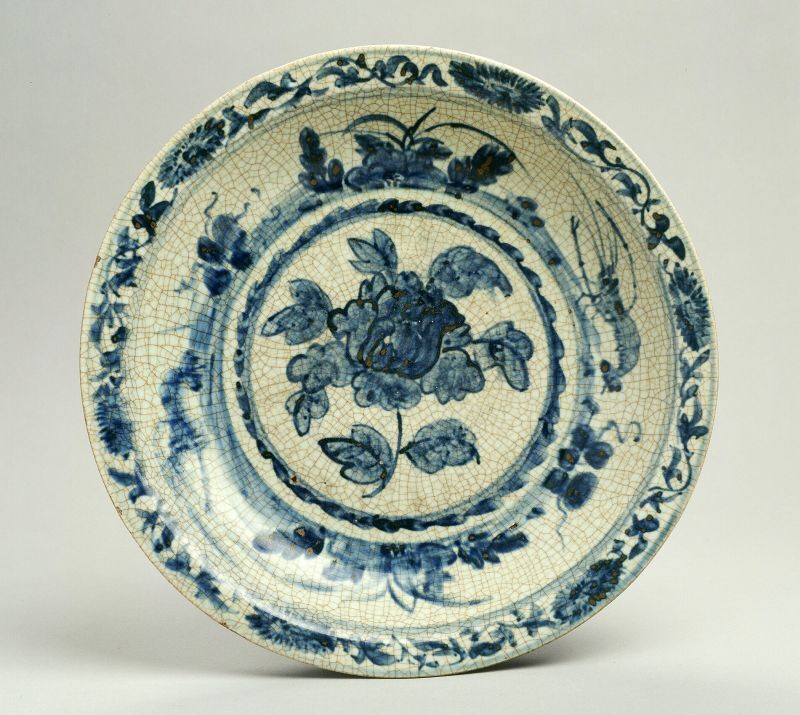
Zhangzhou dish on footring, narrow flat rim. Decorated in underglaze blue. In the centre a single peony spray surrounded by a scalloped band. On the sides water plants and two crayfish, on the rim flower scrolls. On the outside three groups with a large fungus and foliate scrolls. The greyish-white glaze is heavily crackled. Kiln-sand adhering to the base. The decorations on the rim and sides are reminiscent of export porcelain of the late Jiajing and early Wanli period, although they may have been applied at the Zhangzhou kilns for longer than at the more fashion-conscious Jingdezhen. A comparable piece with a single large flower spray as a centre decoration does not appear to be recorded in the literature. Moreover, the motif of a fungus (lingzhi), a symbol of immortality, is rarely seen on Zhangzhou ware.

Swatow dish on footring, narrow flat rim. Decorated in underglaze blue. In the centre a single peony spray surrounded by a scalloped band. On the sides water plants and two crayfish, on the rim flower scrolls. On the outside three groups with a large fungus and foliate scrolls. The greyish-white glaze is heavily crackled. Kiln-sand adhering to the base. The decorations on the rim and sides are reminiscent of export porcelain of the late Jiajing and early Wanli period, although they may have been applied at the Swatow kilns for longer than at the more fashion-conscious Jingdezhen. A comparable piece with a single large flower spray as a centre decoration does not appear to be recorded in the literature. Moreover, the motif of a fungus (lingzhi), a symbol of immortality, is rarely seen on Swatow ware.

Details
Datering
16e eeuw
Materiaal/techniek
gebakken
keramiek
Inventarisnummer
JMD-P-2072
Objectsoort