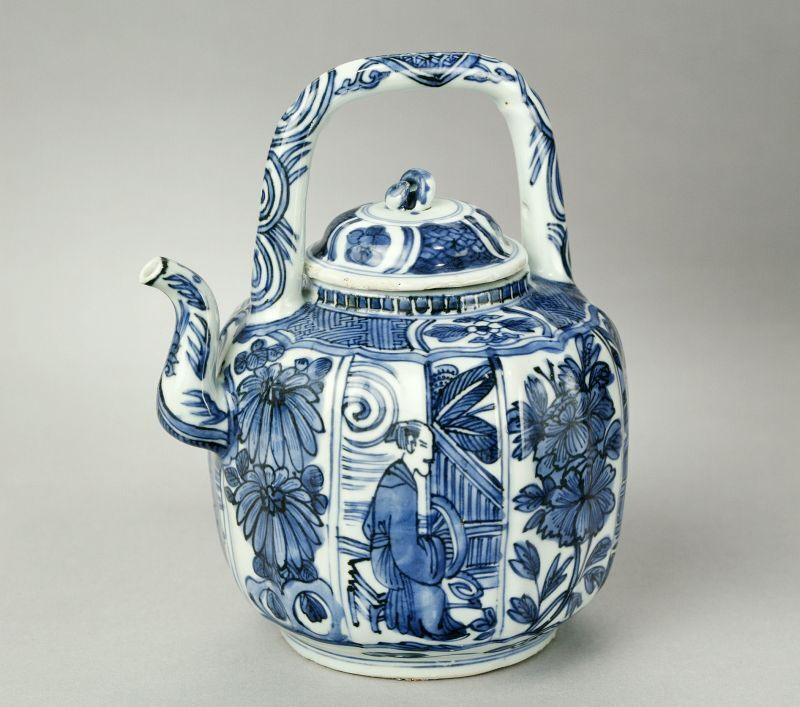
Ketel op voetring, de buik vertikaal licht ingesnoerd in acht vakken, S-vormige tuit en staand handvat. Wijde, lage mondrand met één inkeping voor een bajonet-dekselrand, gewelfd deksel (zonder bajonet-rand) met een knop in de vorm van een vrucht. Kraakporselein, versierd in onderglazuur blauw. In de acht staande vakken om en om een figuur, zittend op een taboeret op een terras, of een grote bloeiende pioen of chrysant. Op de tuit vlammotieven, op het handvat bloemranken, op schouder en deksel schubwerk en vier vakken met een bloem. In de eerste helft van de 17e eeuw was thee nog onbekend in Nederland. Dergelijke kannen, waarvan er relatief veel zijn overgebleven in Nederlandse collecties, werden hier waarschijnlijk voor warme wijn gebruikt. In het wrak van de Witte Leeuw (1613) werden er zeven aangetroffen. Anders dan bij andere typen kraakporselein schijnt de variatie in versiering hierbij nogal beperkt te zijn. Sommige van deze kannen hebben openingen in de mondrand voor een bajonetsluiting, zodat de deksel er niet afvalt bij het schenken; bij andere ontbreekt deze. Het is daarom niet duidelijk of hier het deksel bijpassend is.
Meer informatie
theepot
17e eeuw
Collectie
Jan Menze van Diepen Stichting
Beschrijving
Details
Datering
17e eeuw
Materiaal/techniek
gebakken
keramiek
Inventarisnummer
JMD-P-1731
Objectsoort